
Can veneers ruin your teeth?
One of the most common questions that we get in this office is, "Can I get veneers? Do they ruin your teeth?" It really depends on your starting point and what you're trying to accomplish.
Let's say you have healthy teeth with good alignment, but there are some minor blemishes on your front teeth. If those concerns could be addressed with something more conservative, such as whitening, then veneers may not be the right option because we don't want to alter healthy tooth structure unnecessarily.
But let's say everything is the same except you have chipped edges or other concerns that need restoration. In that situation, we can discuss options such as composite bonding or porcelain veneers. Porcelain is more resistant to staining than composite and can provide a long-lasting aesthetic result, while composite may be easier to repair or modify. The right choice depends on the condition of the teeth and your goals.
Veneers can last many years, but there's no set point when they automatically need to be replaced. If your veneers are healthy, functioning well, and still look good, there's no reason to replace them simply because they've reached a certain age. If a veneer chips, cracks, debonds, or develops another problem, then we'll evaluate it and determine what needs to be done.
Do your teeth have to be prepared for veneers?
In many cases, some tooth preparation is needed for veneers, although the amount varies. There are also selected situations where minimal-prep or no-prep veneers may be possible.
What determines that is really the position and shape of your existing teeth and where we're trying to go. If we can accomplish the desired result while preserving more natural tooth structure, that's what we'll try to do.
For some people, preparation is minimal. For others, veneers may not be the appropriate treatment at all. We may decide that orthodontics, bonding, crowns, or another approach makes more sense. That's a conversation we have during the smile design process.
What is the difference between veneers and crowns?
A veneer primarily covers the visible front surface of the tooth and may extend around portions of the tooth depending on its design. You can think of it almost like a mask over the visible portion of the tooth.
A crown covers much more of the tooth and is generally used when the tooth needs greater structural restoration or protection. You can think of a crown more like a helmet that fits over the prepared tooth.
Are veneers reversible?
Before we do veneers, one thing we can do is give you a trial run. We want to know that this is the right step for you. We may use a digital design or mock-up so you can get an idea of how a veneering solution could look before we begin preparing the teeth.
That gives you an opportunity to look at the proposed changes and decide how you feel about them. But once natural enamel is removed to prepare a tooth for a veneer, that part isn't reversible. The tooth will generally continue to need an appropriate restoration going forward.
Can veneers make teeth sensitive?
Initially, they can. The fact that we've prepared or worked on a tooth can cause temporary sensitivity. For many patients, that sensitivity improves as the tooth settles after treatment.
If sensitivity is significant, persists, or gets worse instead of improving, we'd want to evaluate the tooth to see what's happening rather than assuming it's a normal part of the process.
What makes a veneer look fake?
Natural teeth aren't simply one flat color. When you look closely at a tooth, there are variations in shade, translucency, texture, and how light moves through it. Those details are part of what gives a natural tooth its appearance.
If a veneer is too uniform in color, shape, or opacity, it may look less natural. With porcelain, we can work with different shades, translucencies, contours, and laboratory techniques to create a restoration designed to blend with the patient's smile and aesthetic goals.
What are the risks of cosmetic dentistry?
Any dental procedure has potential risks, and cosmetic dentistry is no exception. Depending on the treatment, those can include temporary sensitivity, changes to natural tooth structure, gum irritation, chipping or debonding of restorations, and the possibility that restorations may eventually need repair or replacement.
That's why careful planning is so important. We want to understand the condition of your teeth, your bite, and what you're trying to accomplish before recommending a cosmetic treatment.
How do you know if veneers are right for you?
It starts with a conversation. You come in for a consultation, and we talk about what you want to change and what treatment may help you get there. We may take photos, scans, or create mock-ups as part of that process.
We've had people come in thinking they want veneers, and after evaluating their teeth, we recommend something more conservative, such as orthodontics or whitening. Other patients may have concerns that veneers can appropriately address.
Whether veneers are right for you really depends on your individual situation. The goal is to choose the treatment that addresses your concerns while preserving healthy natural tooth structure whenever possible.
Are veneers always the right option for a smile makeover?
No. If your teeth are healthy and you're primarily trying to change their color, shape, or certain aspects of their appearance, veneers may be one option. If your front teeth are significantly broken down or already have large restorations, crowns may be more appropriate in some cases.
If your teeth are healthy but simply out of position, orthodontic treatment may be the more conservative approach. That's why the best thing to do is sit down, have a conversation, and decide how to get from where you are now to the result you're looking for.
It's like building a house. You don't use a hammer for everything. Different situations call for different tools, and not every cosmetic concern should be treated with the same approach.
How do we make veneers look natural and last long term?
This is where careful planning really comes into play. We need to understand your bite, what we're changing, and why we're changing it. We also want to make sure the shape, color, and overall design fit your smile and your goals.
That can involve conversations, digital planning, mock-ups, and multiple visits to refine the result. Our goal is to create veneers that look natural, function well, and have the best opportunity to serve you for many years with appropriate care.
At Pacific Park Family Dental, you come first. Whether you need dental care or simply have questions, call us at (360) 803-3546 or email [email protected] to schedule your visit. Our team is here to help you every step of the way.

What are veneers?
A veneer is anything that puts a brand new face on something. For example, if you sand off the top of your table and put on a new veneering piece of wood to make it look nice, that piece of wood would be a veneer. Similarly, with teeth, you can remove a little bit of the surface of the tooth and apply a new material to make the tooth look new, or to change its shape, color, characteristics, length, and even adjust the tilt and rotation using veneers.
How do veneers work?
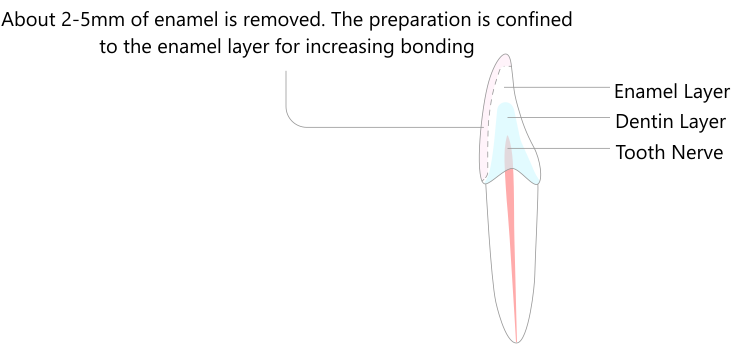
When we're doing a veneer, we strip away a small amount of tooth structure to make space for the veneer. Typically, we cut back about 0.5 millimeters, which is about ten pieces of print paper stacked. After preparing the space, we take a digital scan, send it to the lab, and within two weeks, we get the product. I usually order temporary veneers from the lab so you can check the color, shape, fit, and bite. Any necessary corrections are made on the temporary veneers, and then in two weeks, I deliver the final veneers.
When would you recommend getting veneers?
Anytime you feel like you need to improve your smile or if you have hesitations about your teeth. Reasons could include pitted teeth, discoloration that can't be fixed by whitening, incorrect shape, or persistent stains from drugs, coffee, or tea.
What is the difference between a veneer and a crown?
With a veneer, we're only working with the front part of the tooth, staying conservative to retain most of your tooth structure. A crown involves cutting the back side of the tooth to fit the whole thing on top, like a helmet, whereas a veneer is more like a face mask.
What is the process of placing veneers?
When you come in, I ensure you're numb, then we mock up veneers to adjust rotations, length, or width. After transferring the mock-up onto your teeth, I remove the necessary enamel, preserving what doesn't need removing. We take an optical scan and send it to the lab, providing you with temporaries in the meantime. After a week or two, we try on the temporary veneers and make any adjustments before finalizing the material, either zirconia or porcelain veneers.
Will my veneers match the rest of my teeth?
This depends on whether you want the veneers to match your current teeth or if you'd like to whiten all your teeth. For whitening, we undergo a two-month process using trays or in-house whitening. Once the desired color stabilizes, we prep the veneers to match or brighten your smile.
What is the difference between a composite and a ceramic veneer?
Ceramic veneers are preferable because they don't change color over time unlike composite veneers, which can absorb stains due to their porous nature. Ceramic veneers maintain their color for decades, providing a long-lasting result.
How should you care for your veneers?
Care for your veneers by flossing and brushing regularly. If you grind your teeth, wear a night guard to prevent chipping, which can occur with both ceramic and composite veneers.
How much do veneers cost?
Veneers typically cost between $1,200 to $2,000 per tooth, depending on materials, dentist policies, and whitening involved. My policy includes replacing a veneer at no cost if it breaks or pops off within a year.
Are there financing options for veneers?
Yes, we offer financing through Cherry and Care Credit with 0% financing for a year, allowing you to pay off the balance over time without interest.
Does insurance cover the cost of veneers?
Typically not, as insurance companies see veneers as aesthetic rather than necessary for oral health. However, treating yourself aesthetically can improve confidence and overall personality.
How can you schedule a dental appointment for veneers?
If you're interested, mention it at your next appointment and I'll be happy to discuss it further with you.

A new surface for your tooth
Provides esthetic contour and color corrections, as well as a new surface to a tooth.
What to expect
At the Appointment

Duration 60-90 min

Oral anesthetic use

Possible minor sensitivity

Tooth colored temporary or final
After Appointment
Possible post operative sensitivity to temperature changes

Avoid eating until numbness wears off
What it is
Typically a Veneer is used for:
- Altering shape and finish of a smile side of a tooth
- Altering position of a tooth
- Conservation of underlying healthy tooth structure
- Changing the color of the tooth
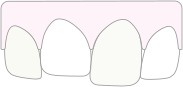

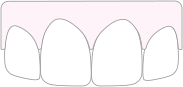
How it is accomplished:

A top layer of enamel is removed in order to make room for the future veneers.

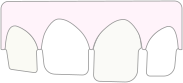
Temporary veneers are placed on the prepared teeth. In this step, its important to go over any changes that should be implemented on the final veneer.

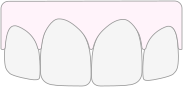
Temporary veneers are placed on the prepared teeth. In this step, its important to go over any changes that should be implemented on the final veneer.
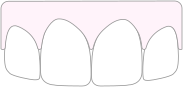
Materials:
Zirconia
Extremely hard material that does not allow any natural color of the tooth to shine through. Great when trying to drastically change the color of tooth, however can appear opaque and color may lack depth.
Porcelain
Has great depth of color and looks the most natural of all restorative materials, however will translate same of the natural tooth color through the restoration. This material does not mask discolored teeth very well, because of this in office whitening is always recommended before veneering a tooth.