
Why do I need professional dental cleanings if I brush and floss every day?
Let me start by asking another question: Why do we brush and floss at all?
We brush and floss to remove something called dental plaque. Dental plaque is a mixture of bacteria, food particles, and salivary proteins that naturally forms on our teeth every day.
Plaque itself is completely normal. However, problems occur when it is not removed regularly. Over time, plaque hardens into something called tartar, also known as calculus.
Tartar is like super glue. It sticks firmly to the teeth and cannot be removed with a regular toothbrush or floss. Once tartar forms, you need the help of a dental professional to remove it safely.
When professional dental cleanings are skipped, tartar continues to build up. Because tartar provides an ideal environment for bacteria, it can contribute to a number of oral health problems, including cavities, bad breath, gum disease, and dental infections.
Gum disease is particularly concerning because, in its advanced stages, it can lead to bone loss around the teeth, loose teeth, and eventually tooth loss.
In fact, gum disease remains one of the leading causes of tooth loss in adults.
How often should I get a dental cleaning?
The answer depends on your individual oral health needs.
For many patients, dental cleanings every six months are appropriate. However, some patients benefit from more frequent visits.
Some people naturally build up tartar more quickly than others. Certain medications can also contribute to increased tartar accumulation. Additionally, patients with mobility challenges, such as arthritis, may have difficulty cleaning their teeth as effectively at home.
Depending on your oral health, we may recommend dental cleanings every three, four, or six months to help keep your teeth and gums healthy.
Do dental cleanings hurt?
No. Dental cleanings should not be painful.
You may experience some minor discomfort if your gums are sensitive or inflamed. During the cleaning, you may feel gentle scraping, pressure, or vibration as plaque and tartar are removed from the teeth.
However, you should not experience pain during a routine dental cleaning.
For patients with sensitive gums, we can also use a topical anesthetic gel to help make the experience even more comfortable. Many patients are pleasantly surprised by how comfortable professional dental cleanings can be.
Do I need a dental cleaning if my teeth don't hurt?
Yes, absolutely.
Many dental conditions develop without causing pain in their early stages. Cavities, gum disease, dental infections, and periodontal disease can all progress without noticeable symptoms. That is why regular dental cleanings and examinations are so important. They allow us to identify and treat problems before they become larger, more expensive, and more difficult to manage.
By visiting Pacific Park Family Dental for regular cleanings and checkups, we can often catch issues early and help you avoid more extensive treatment in the future. Preventive care saves time, money, discomfort, and stress. Even if your teeth feel perfectly fine, regular dental cleanings remain one of the best ways to protect your long-term oral health.
Your dental health matters to us, and we’re here to support you every step of the way. If you’re looking for expert dental care near Vancouver, WA, call (360) 803-3546 or email [email protected] to learn more. Ready to get started? Schedule your appointment below.

What are four types of dental cleanings?
The first cleaning is prophylaxis. This is when you're healthy, your gums are healthy, you floss every day, all we need to do is just remove a little bit of plaque and calculus, and everything is good. This usually happens once every six months. As long as you keep up with that, there should be no problems. Continue your brushing and flossing, and you will never have gum or bone problems in your life.
The second type of cleaning is scaling in the presence of inflammation. Although it sounds intimidating, it is not very different from a regular cleaning. A regular dental prophylaxis involves removing light calculus and plaque. Scaling in the presence of inflammation implies that more work is needed, but there is no bone loss around the teeth. We clean more plaque and calculus (or tartar) but the bone remains healthy. The gums, however, are inflamed. Cleaning out the plaque and calculus that has accumulated over the years allows the gums to return to health without bone loss. If you need scaling, get it done to keep your gums happy.
The third type of cleaning is scaling and root planing. This means that bone level has been lost, and the roots are exposed. To calm the gums and promote health, we clean the roots. Without this, the bone may resorb, causing the tooth to fall out of its socket. Scaling and root planing, commonly known as deep cleaning, involves cleaning deep underneath the gum around the tooth root to remove calculus and prevent gum irritation. This procedure is usually done under local anesthesia to prevent sensitivity.
After deep cleaning, we move to the fourth type of cleaning, which is periodontal maintenance. This is necessary to maintain the results of the deep cleaning. It's like doing a major house clean; after that, you only need to perform regular maintenance. Similarly, after a deep cleaning, we perform periodontal maintenance every three to four months to keep the gums healthy and prevent the need for another deep cleaning.
What happens if teeth are not cleaned regularly?
Despite our best hopes, not everyone achieves perfect oral hygiene. Everyone misses a bit of plaque and calculus, which is why professional cleaning every six months is necessary. When teeth are not cleaned regularly, plaque and tartar accumulate, housing bacteria that irritate the gums. This can lead to bone level reduction around the tooth root, causing teeth to become wobbly and eventually fall out. Regular cleanings prevent this, ensuring healthy teeth and gums.
Do regular dental cleanings improve your dental health?
Yes, absolutely. Regular dental cleanings reduce plaque and calculus, which in turn reduces inflammation, irritation, and bacteria, significantly improving dental health.
How often should I get my teeth cleaned?
If you're healthy, ideally twice a year. If you have had bone loss, three to four times a year is recommended.
How does a dentist do a deep cleaning?
We perform a deep cleaning by first numbing the area to prevent pain, as the procedure involves cleaning deep into the root of the tooth and gum. We use ultrasonic and manual instruments to smooth the tooth root and remove tartar and calculus. This helps the gums become healthy, pink, and firm, reducing bleeding during brushing or flossing. An x-ray is taken afterward to ensure that all tartar and calculus have been removed.
Do dental cleanings remove tartar?
Yes, they do. That's the primary purpose of dental cleanings.
Do dental cleanings make teeth whiter?
A dental cleaning does not change the intrinsic color of the tooth. It removes external stains from pigmented drinks and cigarette smoke, restoring the tooth to its original color. However, for intrinsic whitening, we offer take-home bleach services or in-house whitening services.
Does a hygienist's teeth cleaning usually hurt?
Dental cleanings do not usually hurt, but they can cause slight sensitivity, especially in areas where gums have receded. In such cases, you can ask your hygienist or dentist to use manual instruments or to numb the area.
How can I schedule a teeth cleaning appointment?
If you'd like to be seen here at Pacific Park Family Dental by my partner, Dr. Joe, or myself, please text or call (360) 803-3546.
The History of Dental Cleanings
Professional dental cleanings may seem like a modern service, but the importance of keeping teeth clean has been recognized for thousands of years.
In fact, records from ancient Egypt show that early civilizations documented instruments and techniques used to clean teeth. Even then, people understood that the buildup of food particles, bacteria, and mineral deposits on teeth could shorten their lifespan and lead to oral health problems.
Without proper dental care, tooth loss was much more common, and people often lost teeth at a much younger age.

How Dentistry Has Evolved Over Time
Fast forward to the 1700s, and dental care looked very different than it does today.
During this time, many dental procedures were performed by "surgeon barbers." These individuals cut hair, removed teeth, and sometimes even performed surgical procedures. Dentistry was not yet recognized as its own specialized healthcare profession.
That began to change when Pierre Fauchard entered the field.
The Father of Modern Dentistry
Pierre Fauchard is widely known as the father of modern dentistry because he recognized that oral health was an important part of overall health.
He developed specialized dental instruments and techniques designed to remove harmful buildup from the teeth and help people maintain healthier smiles for longer periods of time.
Many of the principles he introduced continue to influence modern dentistry today.
The Importance of Dental Hygienists
Another major milestone occurred in 1913 when the profession of dental hygiene was established.
The introduction of dental hygienists revolutionized preventive dental care. Dental hygienists focus on helping patients maintain healthy teeth and gums through routine cleanings, education, and preventive treatment.
This advancement changed the way dentistry approached long-term oral health and helped countless patients keep their natural teeth for much longer.
Why Regular Dental Cleanings Matter
One of the things I can often tell immediately when examining a patient is whether they have been consistent with their dental cleanings over the years.
When I see an 80-year-old patient with healthy gums, strong bone support, and very few restorations, there is a good chance they have been seeing their dental hygienist regularly throughout their life.
On the other hand, patients who have not had access to regular preventive dental care often experience more tooth loss and more complex dental problems over time.
Dental hygiene is one of the most important foundations of long-term oral health.
The Secret to Keeping Your Teeth for Life
If your goal is to keep your natural teeth well into your 80s, 90s, and beyond, routine dental cleanings are one of the best investments you can make in your oral health.
Regular professional cleanings help remove tartar buildup, support healthy gums, and allow dental problems to be identified before they become more serious.
Simply put, preventive care is one of the biggest reasons many people are able to keep their natural teeth for a lifetime.
Schedule Your Next Dental Cleaning
If it's time for your next dental cleaning, the team at Pacific Park Family Dental is here to help. Regular preventive care can help protect your smile, support your overall health, and keep your teeth healthy for years to come.
At Pacific Park Family Dental, you come first. Whether you need dental care or simply have questions, call us at (360) 803-3546 or email [email protected] to schedule your visit. Our team is here to help you every step of the way.

A 6 month cleaning appointment will tackle hard to clean areas as well as give you a snapshot of your oral health.
What to Expect
At the Appointment

Duration usually 40-60 min
After Appointment

Possible sensitivity to cold for a few weeks
What it is
With normal function plaque, which is made up of left over food particles precipitates onto teeth creating a biofilm of food and bacteria.
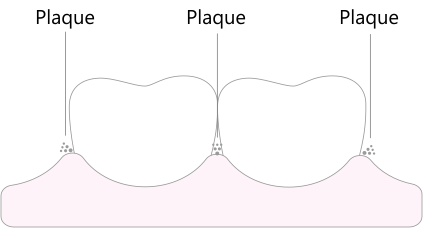
Overtime the settled biofilm of food and bacteria becomes calcified with calcium that is supplied by saliva. Once calcified the plaque becomes rough and hard turning into calculus.
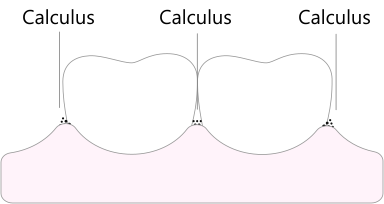
If not taken care of in timely manner calculus will irritate the gums making them tender and sensitive. This is called Gingivitis.
In Gingivitis only gums are affected however the bone level around the teeth remains healthy and unaffected.
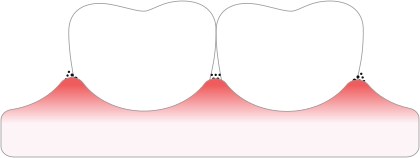
Presence of Calculus can cause:
- Inflamed gums
- Sensitive gums
- Bleeding gums
- Pain upon biting
- Gum recession
- Bone loss
- Bad breath
- Gum infection
Regular dental cleanings on a 6 month schedule help disrupt formation of calculus in order to maintain gingival health. This prevents heavy calculus build up and development of periodontal disease.
How the cleaning is accomplished
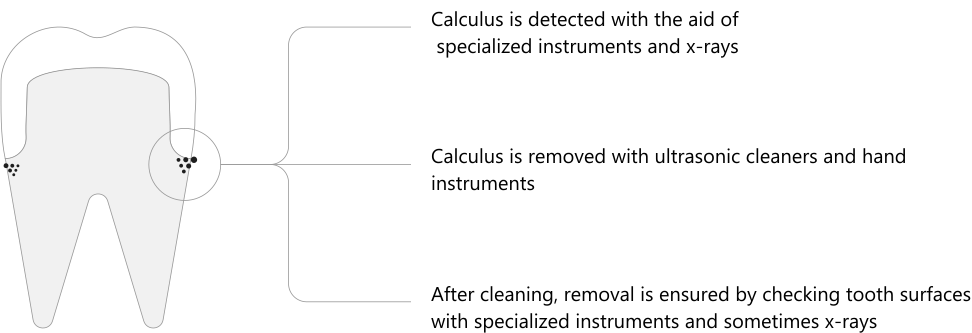
Once all the irritants are removed gums will start repairing themselves.
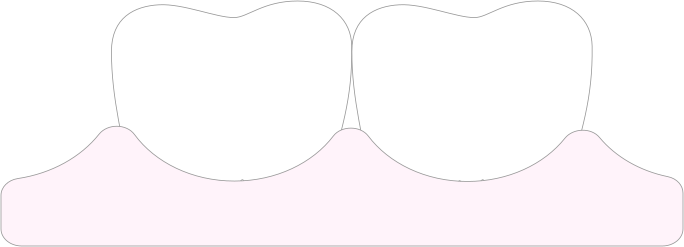
2 weeks after cleaning:
- Gums become less sensitive
- Bleeding stops
- Discomfort resolves
- Risk of recession is lowered
- Risk of bone loss is lowered
- Bad breath disappears